
Supportive Housing
Everyone deserves a home.
Supportive housing brings together housing assistance and support services like behaviour supports, counselling, life skills training, and activities of daily living, so people can live as independently as possible. Long term care homes, group homes for people with developmental challenges and residential homes for the medically fragile are all examples of supportive housing in our community. Many other communities in the province also offer supportive housing for people who are exiting homelessness, some of whom also experience mental health conditions and addiction. The County of Lambton has identified new supportive housing for such people as an urgent need.
H.O.M.E. Sarnia Lambton supports all types of supportive housing, but we specifically advocate for supportive housing that's designed for people exiting homelessness.
Supportive housing combines three things:
Why does supportive housing work? Because all three elements are under one roof. It’s as simple as that.
Supportive housing is usually run by a non-profit or charity, and funded by donations, government grants and financing. Operational costs are shared with different levels of government, and oversight is provided by the local Ontario Service Provider and the Ontario Ministry of Health.
The success of supportive housing has been demonstrated over and over in communities across Ontario. In 2023, Western University in London published an in-depth report confirming that permanent supportive housing reduces homelessness. The report author was Prof. Abe Oudshoorn and you can read the story here.

Emergency Shelter
An emergency shelter provides immediate, short-term accommodation for people experiencing homelessness or who are in crisis. Shelters offer a safe place to stay while individuals work with service providers to address urgent needs and identify longer-term housing options. Emergency shelters are designed as temporary solutions and are often the first step toward finding permanent housing.
Supportive Housing
Supportive housing combines safe, permanent housing with individualized support services that help people maintain their housing and improve their well-being. Residents have their own home while receiving access to services such as mental health care, addiction recovery support, life skills coaching, employment assistance, and healthcare coordination. Participation is based on individual needs, with the goal of helping people build stability, independence, and long-term success in the community.
Affordable Housing
Affordable housing provides safe, stable homes for individuals and families with low to moderate incomes. Rent is offered at a price that is manageable based on household income or below current market rates. Residents live independently and are responsible for their day-to-day needs. While some community services may be available, affordable housing does not include ongoing on-site support or case management.
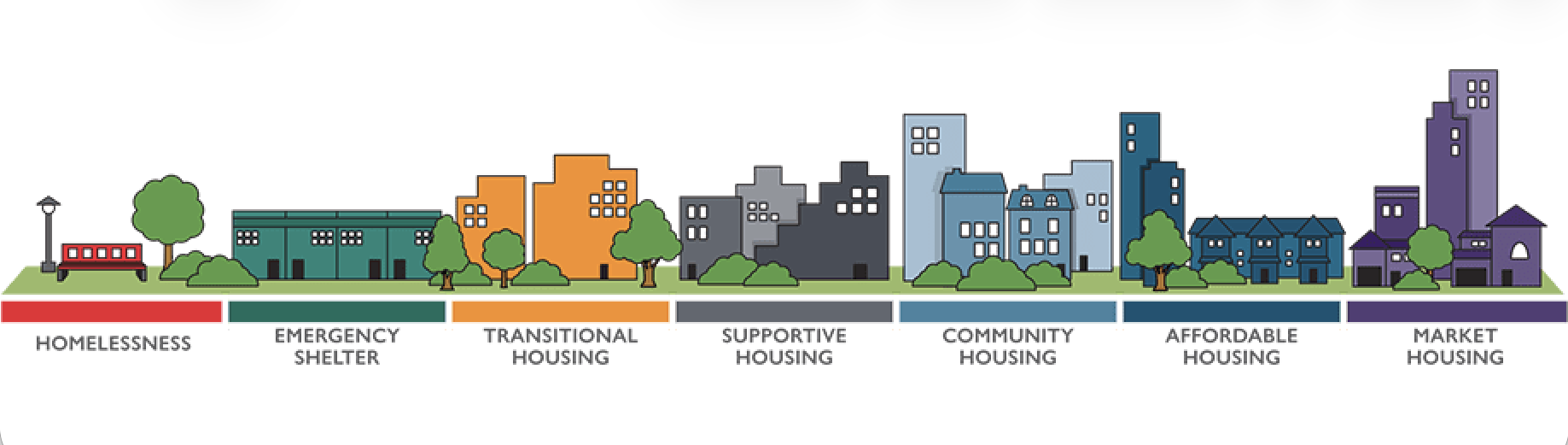
Together, these options form part of the housing continuum (the range of housing needed in a community, from emergency shelter and supporotive housing to affordable rental and private market housing) that helps people move from crisis to stability, while ensuring the right level of support is available at the right time.
How They Work Together
Housing needs are different for every person. A strong community includes all three housing options because each serves a different purpose.
Emergency shelters provide immediate safety during a crisis. Treatment and recovery programs help people address challenges such as addiction, mental health concerns, or trauma.
Supportive housing offers permanent housing with the services needed to maintain stability and independence.
Affordable housing provides long-term housing for people who are able to live independently without ongoing supports.
Fewer hospital visits
In Toronto, the University Health Network opened Dunn House in 2024, a supportive housing complex for people who used to live on the streets. Since moving in, residents have drastically reduced visits to the hospital’s emergency department, according to the CBC. The mayor, Olivia Chow, says “This is the model that breaks the cycle of homelessness, sickness, and despair … This is where hope lives.” Dunn House is so successful that the University Health Network is currently building a twin building.
No more living rough
In St. Thomas, a new supportive housing building opened in 2024, and now, according to a CBC report, the community has reduced homelessness by 30%. The Station, as the building is called, is owned and run by Indwell.
And innovative design
Supportive affordable housing today is not the drab apartment complex of the past. Instead, the new buildings embrace innovative design and boast outstanding green credentials, with the twin goals of making these great places to live and adding character and prestige to neighbourhoods. For instance, many of Indwell’s multiresidential buildings incorporate passive house technology, as recognized by Passive House Canada. In Toronto the St. Clare Multifaith Housing Society opened a new 25-unit building for people leaving homelessness. It caught the eye of a leading architecture journal, Canadian Architect, owing to its innovative, compact design.

